NASA's Roman Space Telescope Begins Mission to Map the Universe
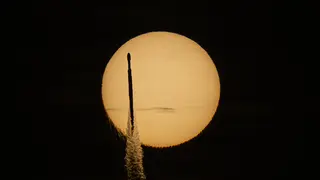
NASA's Roman Space Telescope launched on a Falcon Heavy from Kennedy Space Center on August 29. The observatory, with a 300-megapixel camera, will survey the cosmos and downlink 2,500 terabytes of data over five years. It aims to study dark energy, dark matter, and exoplanets.
The telescope’s 7.9-foot primary mirror, originally built for a classified spy satellite, was donated to NASA, significantly reducing costs. Its wide-field camera can capture images spanning 45 city blocks in a single exposure, while its position at Lagrange Point 2, a million miles from Earth, offers a stable vantage point for continuous observation. The mission’s five-year survey will generate 2,500 terabytes of data, roughly 15 times Hubble’s entire archive, enabling rapid scans of the sky.
Roman’s design prioritizes speed and breadth over Hubble’s deep, narrow views. By mapping vast cosmic regions, it will complement the James Webb Space Telescope’s targeted observations, providing a census of dark matter’s distribution and cataloging exoplanets across the galaxy. The telescope’s namesake, Nancy Grace Roman, championed space-based astronomy in the 1960s, and this mission extends her legacy of broad cosmic surveys.
Roman’s data could reshape fundamental physics by refining models of dark energy and dark matter, potentially influencing future space missions and theoretical research. Its exoplanet surveys may identify new worlds for follow-up study, possibly accelerating the search for habitable environments. The mission’s public imagery and discoveries could inspire renewed interest in astronomy, while its rapid data release may benefit researchers worldwide, though the sheer volume will require advanced analysis tools. Society may see tangible benefits in technology transfer and STEM education, but the full impact will depend on how quickly scientists translate raw data into accessible knowledge.